Showing posts with label China. Show all posts

Friday, March 25, 2011

An evening with Sze Tsung Leong


Sze Tsung Leong is a traveler. He was born in Mexico in 1970, and spent his childhood in Mexico, Britain and the US, before moving to China. He is now based in New York but he travels the world to reveal its History recorded in urban landscapes. He is fascinated by cities. Probably because he was an architect before capturing his large detailed landscapes with a 8x10 camera.
He is also what we could call an intellectual photographer. His series are very esthetic but essentially extremely well thought out. More than the emotional aspects of his photographs – not saying that this is missing - what I recall is their message or more precisely their multiple meanings. He started his lecture by acknowledging the fact that if his work needed to be explained it meant that it was a failure. He has written many essays about his work and given his own very interesting interpretation without forgetting that of course everyone could and should find their own.
His inspiring work is about History, societies, civilizations and globalization. It’s about the transformation of the world, about its contrasts and similarities, about its power and fragility. It’s also about its pictorial aspects, about lines, shapes, textures and colors.
 Cities are the mirrors of change, they are larger than the people who inhabit them, they are the results of stronger forces that cannot always be controlled, from geological power to political or religious beliefs.
‘Smash the old world, build the new world’.
The first series called ‘History Images’ and exclusively shot in China is the perfect representation of this popular Chinese slogan from the 60s or 70s.
The powerful Chinese regime has the ability to change the look of their cities by erasing the old to start from scratch. From the imperial period to the socialist regime to the rise of a capitalist economy, Chinese landscapes tell it all. But coexistence between these different periods doesn’t last. Sze Tsung Leong’s photographs perfectly depict this ephemeral and quite sad situation. 

Nan Shi, Huangpu District, Shanghai, 2004

Shibati, Yuzhong District, Chongqing, 2003

Xinjiekou, Xuanwu District, Nanjing, 2004

Beizhuanzi II, Siming District, Xiamen, 2004
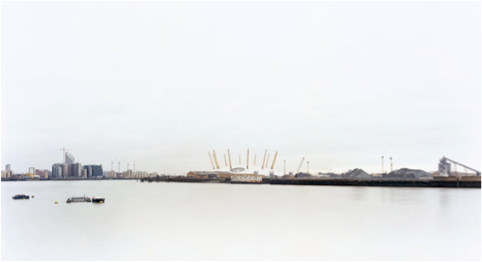
 ‘Horizons’ : the separation between the sky and the earth, between the known and the unknown, the limit to our vision, the center point of Sze Tsung Leong’s images.
This series (that probably has to be seen on a wall to become even more beautiful) drives parallels between landscapes of the world and makes us search for similarities and differences. Visually but also through our own experiences of these places we look for clues to recognize these untitled environments. We search for connections, associations and contrasts. The images leave us with our own very personal questions, answers and feelings. 

Installation of Horizons at Yossi Milo Gallery, 2008
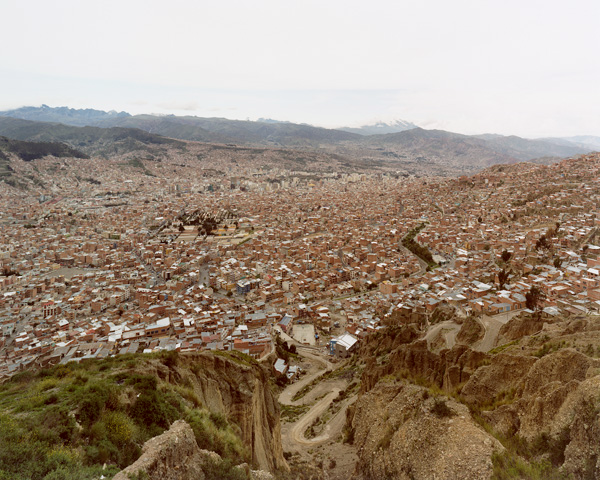
 His latest series is simply and most naturally called ‘Cities’. In contrast with the previous set of images shot at ground level and from a distance here we climb higher to get a full closer view and the maximum detail possible. Once again Sze Tsung Leong questions our relationship to the world, the link between cities and History, globalization through different period of times (from Spanish colonization to the spread of capitalism). But most of all he lets everyone make their own interpretation and drive their conclusions; this is not about accusing humanity or making any statement about the future. His large-scale urban images simply provide a direct, accurate and universal testimony of where our civilization stands today.

Xiasha Village, Futian District, Shenzhen, 2008

La Paz, 2010

Houston II, 2010

Nairobi I, 2009
More on Sze Tsung Leong : www.szetsungleong.com

Friday, February 18, 2011

Meet Ferit Kuyas at 291 Gallery in San Francisco


Ferit Kuyas’ new exhibition ‘City of Ambition’ at the 291 Gallery in San Francisco (291 Geary Street) runs until April 23rd. That should leave enough time for everyone interested to visit it. And believe me, it’s worth it!

Ferit Kuyas was born in Istanbul, Turkey in 1955. He studied architecture and law in Zurich, Switzerland and graduated from the University of Zurich in 1982. Working mainly on personal projects, he published several books. His photographs have been shown in museums, galleries and festivals around the world.
I had the chance and great pleasure to meet Ferit Kuyas at the gallery for an open conversation about his work and experiences in creating this body of work about the riverbank of the Changjiang River in China.
His work directly reminded me of Nadav Kander’s series on China (read my post from Feb. 4th). And in fact I was right, the Changjiang River is also called the Yangtze River and some of their images have been shot at the exact same locations! They don’t know each other, even if they met once at a photography show, so no one has really influenced the other but Ferit Kuyas completely acknowledges the similarities of their work. The way they decided to photograph the Yantze river is very similar as they are both presenting landscapes of a quickly evolving China. But While Nadav Kander shows ‘humans dwarfed by their surroundings’, Ferit Kuyas focuses on the landscapes, the fog, construction sites. The human presence is tangible but in a very subtle way.
The main difference might also come from the fact that one is an outsider depicting the smallness of the people in this gigantic environment, while the other is personally connected to the place. Ferit Kuyas’ family in law lives in Chongqing. With his photographs he shows us the pride of the inhabitants, and captures their relationship with their city while very rarely depicting them.
The exhibition at 291 Gallery presents a selection of 20 large 4x5 photographs of the ‘City of Ambition’ project. The pictures depict a moody and enigmatic city with its buildings, unfinished development projects and living spaces. They all have a mysterious dreamy power that surrounds you and takes your breath.


 ‘I am mainly interested in the outskirts of Chongqing, where the city can’t be really seen but sensed, like a tiger moving through the jungle – invisible, yet there.’

Changjiang River. Beibin Road. Chongqing, China 2005

Jialing River. Huanghuayuan Bridge. Chongqing, China 2005

Jialingjiang Rivershore Drive. Jialing River. Chongqing, China 2005

Caiyuan Bridge. Changjiang River. Chongqing, China 2007

Restaurant Boats. Changjiang River. Chongqing, China 2005

Restaurant Boat. Egongyan Bridge. Chongqing, China 2008
Learn more on Ferit Kuyas: www.feritkuyas.com
Learn more on 291 Gallery: www.gallery291.net

Friday, February 4, 2011

Nadav Kander


Nadav Kander is a photographer born in Israel in 1961, who grew up in Johannesburg. He started photography at 13 and now lives and works in London..
I discovered his work at Paris Photo 2009, as he just won the second Pictet Prize on the theme “Earth”. He is in fact recognized as one of the most original and highly regarded photographers of our time.
The photographs that really caught my eyes at that time were from “Yangtze, The Long River”, a project realized through several trips in China.
Large, empty, foggy and moody landscapes where the presence of men appears like the last soul on earth. An unbelievable feeling when you know that more people live along the Yangtze River’s banks than in the whole of the United States.
For me the images show both beauty and emptiness, even sadness. While first looking at them, you forget the meaning of the situation there to just see the harmony of the scenery; but after a little moment you understand the deep reality of what is in front of your eyes.
By looking at the pictures, you can sense what Nadav Kander was feeling when he was there: “I felt a complete outsider and explained this pictorially by “stepping back” and showing humans dwarfed by their surroundings. Common man has little say in China’s progression and this smallness of the individual is alluded to in the work.”
"China’s landscape both economically and physically is changing daily. These are photographs that can never be taken again."


Here is a video where he explains his work.


Nadav Kander has also photographed the entire administration of Barack Obama (photos published in The New York Times)
He’s also done great images of American landscapes.
  
Discover much more on:  http://www.nadavkander.com